
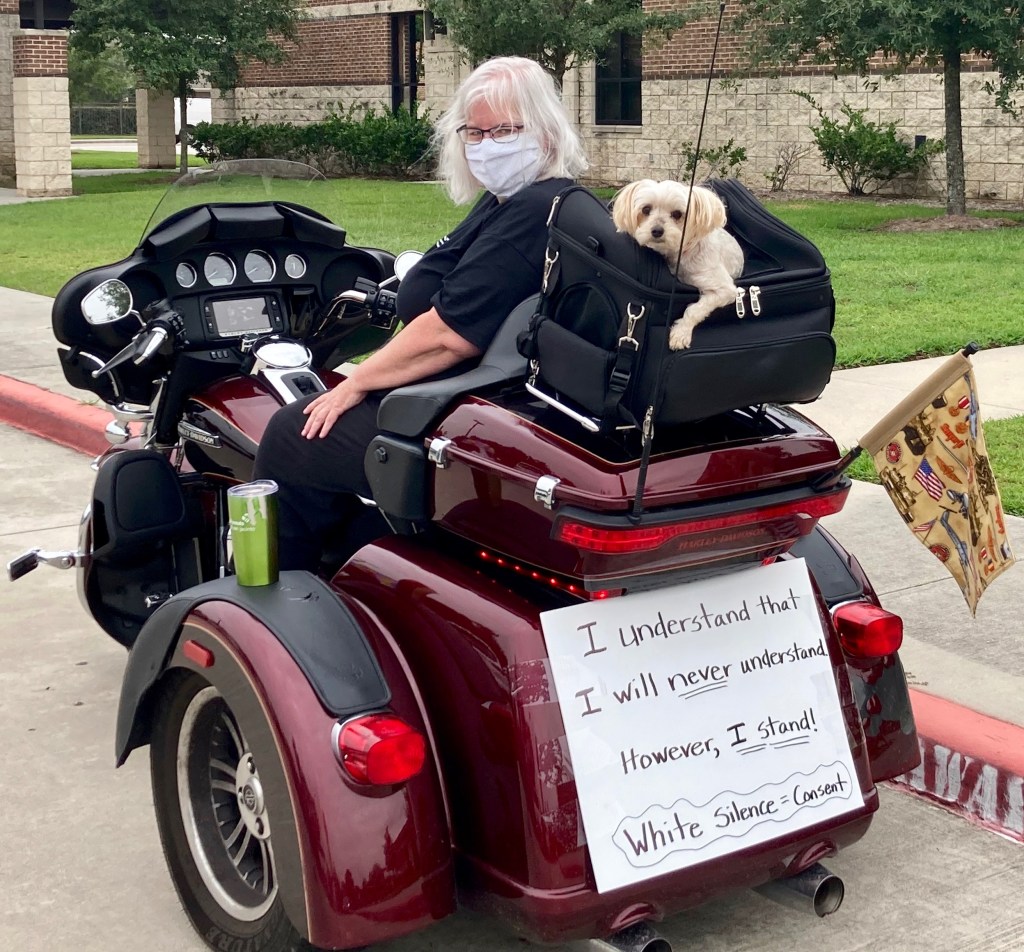
Already about a dozen cars had converged when Glenn and I arrived at Fall Creek Elementary in Humble, Texas recently for the Fall Creek Together Unity Car Parade. The parade was an equal mix of Black* and white families, with one or two Latinx families. Most of the posters hung in windows shared statements about racial unity, and a few hung Black Lives Matter signs. Most of us stayed in our cars as we waited for the parade to begin, since the point was social distancing. I did get out to take a few photos, though, such as of an awesome pup and her awesome mama:
Glenn is almost always willing to be the offbeat sidekick in my adventures. Today was no exception. When I noticed he’d brought along a book, I teased him: “Sweetheart, I don’t know what kind of parades you’ve been to, but I’m pretty sure reading isn’t something you do in a parade.”
“Yes, it is. Reading is the best thing to do in a parade,” he countered. I sighed, thinking, my husband is a handful!
“Okay, fine, read during our parade,” I said. “But you also have to put a hand out the window to wave.”
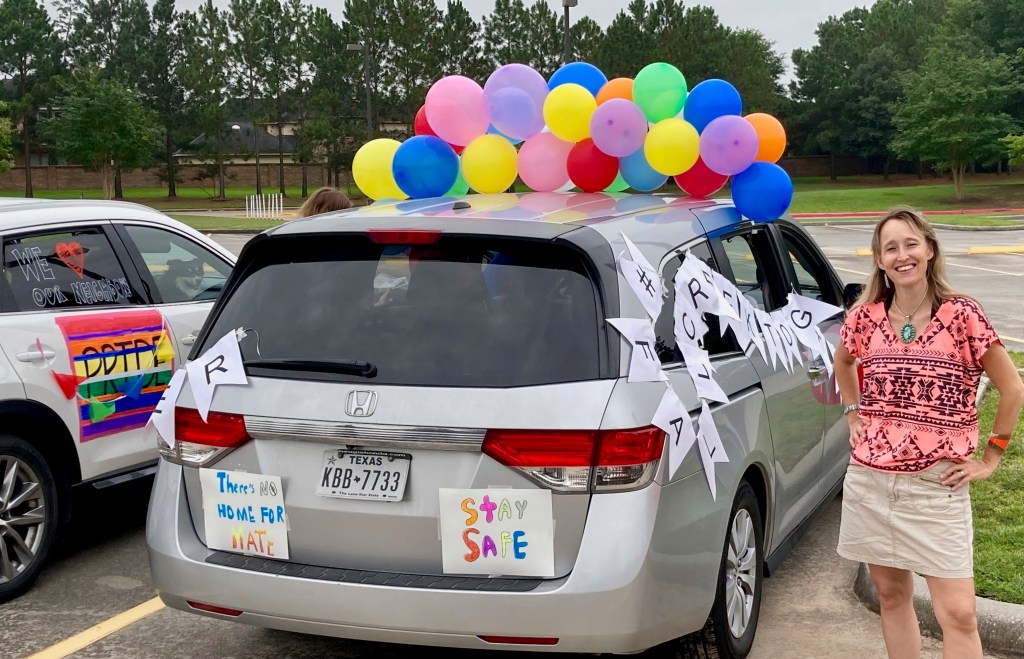
Glenn soon forgot about his book, because being in a parade was way too engaging to read through. In each “village,” as they call the subdivisions of Fall Creek, families had gone into their yards with “Black Lives Matter” signs and other signs made by kids. Families waved and clapped and cheered as we passed—down the line, our car parade honked back. Before every turn, we wondered, would people be outside to cheer for us? We hoped so—being supported made the experience exciting. Families of all races stood and waved from their lawns, including mixed race families. Kids cheered us along, including ones as young as three. The previous night I had texted nearby neighbors in our village, Shadow Brook, a heads-up about the parade—amazingly, five families—two Black and three white families—had assembled in full force to celebrate.
The murder of George Floyd filled me with grief, as it did for many Americans. So did the murders of Ahmaud Arbery and Breonna Taylor and so many other People of Color murdered by whites, who often get away Scot-free. The statistics of Latinx and Black Americans being more than twice as likely as white Americans to die from Covid-19 was also heartbreaking. The death tallies shine the light on America’s system of social and economic racism kept in place by upper- and middle-class whites who tout the importance of freedom while offering it only to themselves and other upper- and middle-class whites. I hurt for Black Americans and for America. Based on conversations with family members, videos of infuriated Karens**, and rampant racism across Facebook, I was beginning to see the hatred and fear that rule the hearts of many white Americans, even those who attend church and claim to be Christians. I wanted to help. But how? What could one middle-aged white woman who recently had her eyes opened even do? I was glad people were protesting, but my husband is in an at-risk age bracket for Covid-19. We’d agreed to be extremely cautious, so joining crowds in downtown Houston was out of the question.

A car parade to show support for racial justice and human rights seemed perfect. Car parades are Americans’ new ritual to show love on birthdays and graduations during these times of social distancing. Rituals are transformative, regardless of the form they take. Rituals lead us from one place to another: They can carry us from one stage of life to the next, from one level of expression to the next, or from one state of understanding to the next. Every ritual produces different transformations, but in the Fall Creek Car Parade, the passage I witnessed was the passage from private anger to public unity and from private grief to public celebration. After so much time spent suffering alone, I felt so much better upon witnessing—in the cheering families and our fellow car paraders ahead and behind us—that my pain and my desire for change are shared, and therefore so much larger and more powerful than I am. Through our car parade, we transformed our grief into hope. I am so grateful that the first time we got to experience a car parade, we did so in such a meaningful way—by showing love not just for one person (as with birthdays and graduations), but for millions of people—the past, present, and future of a race: To show respect for Black Americans, without whose contributions of intelligence, strength, and beauty, America would not and could not exist. As we drove and honked and waved, I felt I could joyfully drive and honk and wave and shine with love forever.
* I capitalize Black and not white because the AP Style Guide recommends it. You can learn more here.
** A Karen is an entitled white woman who goes ballistic on a Person of Color for politely asking her to follow the rules—such as putting her dog on a leash or wearing a mask. Karens believe they are better than everyone—in particular, People of Color. A Karen will pull out and aim a gun, if she has one handy—and she often does. She will threaten to call the police, though she is the one swinging a gun.
 Elizabeth White Olsen